
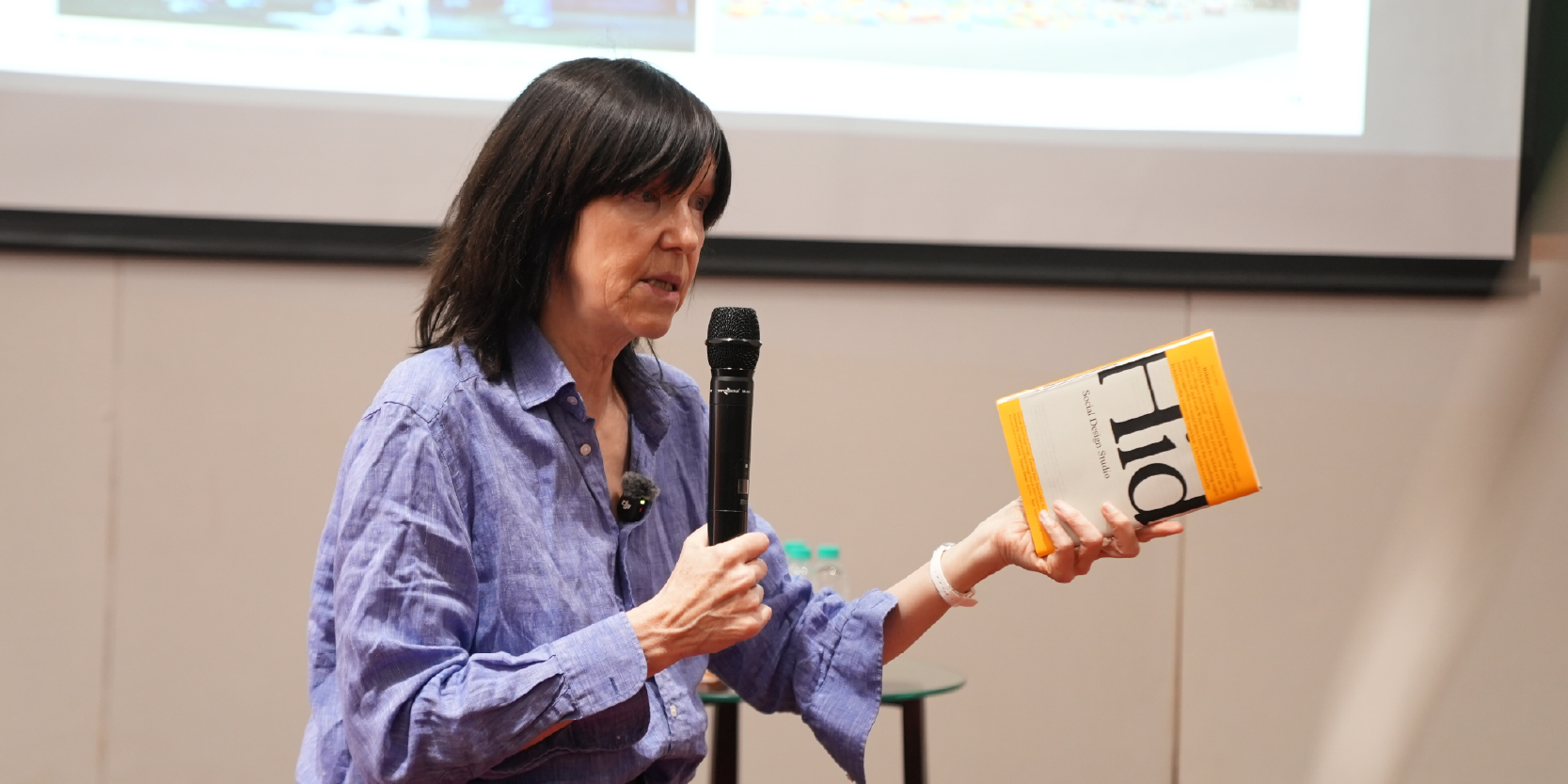
A Social Design Summer School focusing on material and immaterial resources of the city
with the Social Design Studio of the University of Applied Arts Vienna, Austria,
together with Bogomir Doringer
and Florian Part
in collaboration with Vidyashilp University Centre for Art, Design and Innovation, Bengaluru
As of the same importance as the material qualities of spaces, it is also the everyday practices, ephemeral moments and immaterial resources – such as history, social networks, cultural norms, neighbours’ skills and care-taking – that make up the urban fabric. What site-specific methods can we develop to understand a place in all these dimensions? How can both material and immaterial resources become the starting point for careful transformation?
By pooling the knowledge and skills of transdisciplinary teams from areas such as the social sciences, environmental chemistry and waste management, digital arts, design, visual arts, administration, architecture, landscape and planning, we will develop and apply site-specific methods for researching the everyday, ephemeral, immaterial and material qualities of urban spaces, with the aim of reimagining and remaking a possible circular future.
The program of the SD Summer School 2026 evolves along material as well as immaterial resources of urban spaces. We will address the urban fabric both as a process and a result of material cycles but also social production, within contradictions between circularity and scarcity of both material and immaterial resources, where values of care, notions of precautionary principles and not least of an activating and possibly activist stand on potential changes, empowerment and emancipation are regarded as crucial factors. Since we do not want to refrain from future, we aim to conceptualize strategies of real utopias, of strategies to lead a productive, circularity-driven, independent and joyful life in obvious and imposing contradictions.
The program will be provided by a group of scholars, scientists, curators and activists arriving from Vienna, Amsterdam and Belgrade coming also from differing fields and methods of theory and practice, ranking from Environmental Chemistry to Digital Activism Research as well as Critical Urbanism, Spatial Sociology and Curatorial Practice in popular culture.
The summer school will evolve in a regenerative public landscape, an urban void inhabited by more than humans, neglected on one hand and receiving high attention on the other. This piece of land will be conceptualized as a model for urban regeneration in the specific context of Bangalore and the accelerated growth the city is undergoing with all the impact on green and blue spaces.
We regard this 1-week summer school as an important acupuncture which will – positioned on the right spot – still trigger effects and further reflection.
Tasks will be theoretically based and practically applied to the area – and will follow own individual perspectives and interests. We will focus on waste and its circularity potentials, on digital presence of public spaces, on the invisible regulations of public space and on the impact and responsibilities city dwellers will have on their direct environment taking action and enacting the city they hope to bring into being.
The faculty will share:
1) Insights into of waste regulations, recycling technologies, concepts for safe and sustainable by design, as wells as design for disassembly and circularity. 2) Perspectives of how upcoming generations – children and adolescents – appropriate public spaces outside institutional spaces and how they establish relations with the world around us and them, 3) Digital methods to raise awareness, and to strengthen knowledge production to promote exemplary actions, 4) Practical approaches of co-research and co-design for building meaningful collective engagement.
In order to oppose “experimental starvation” we will think and dream limitless in order to develop a toolbox of artistic strategies, of visions leading to real utopias, design concepts, social tactics and feasible measurements to literally lay ground to an urban area providing a space which should be thought of as existential for the further urban change of the city.
The toolbox will be publicly feedbacked with local community representatives coming from activist groups, city administration, research, social design.
Site visits (tbc) will take us to the Centre for Community Dialogue and Change, an organization committed to the promotion of Theatre of the Oppressed in education in Bangalore, to the Mavallipura Landfill, and the Mavallipura village, the Rail Wheel Factory, located in a garden in Yelahanka, and the factory’s strategies to work in a sustainable way applying circular processes of material resources and practical conditions of labor.
During breakfast sessions participants will share knowledge and methodologies, in the afternoons and early evenings we will work in “our” garden on concepts for a circular future. The evenings will be devoted to discussions with guests from local expertise, to movie screenings and common barbecues on the ground.
The summer school is open to people coming from diverse interest groups and persons responsible for the management of raw materials, wastes respectively immaterial resources as well as from academia in the studies of social sciences, administration, design, visual arts, urbanism, architecture, landscape and planning, all with a clear commitment and engagement in the matter.
Please, apply until June 25th 2026, with a letter of your individual motivation and a short cv. A jury consisting of the Summer School faculty and representatives of the Vidyashilp University Centre for Art, Design and Innovation, Bengaluru will decide about the admission of 15 participants until June 30th, 2026.
Deadline : June 25th 2026, 00:00 IST of the online submission
One (1) PDF including:
Bogomir Doringer is a Serbian-Dutch (1983) artist, filmmaker, curator, and researcher based in the Netherlands. He is best known for exploring how social and political changes show up in human behavior – especially through ritual of masking and dance, nightlife, and collective movement. His interest is also in how bodies consciously or unconsciously react or resist to new technologies. He has been involved in developing and shaping Nxt Museum in Amsterdam, focused on new media, art, and technology as well as Synergy Foundation and Synergy Art Festival.
Brigitte Felderer, curator, head of department “Social Design-Arts as Urban Innovation” at the University of Applied Arts Vienna. Her projects focus on themes within the field of cultural history and technology and have been shown internationally. In her projects as well as in her teaching, Brigitte Felderer pursues trans-disciplinary and cross-topic questions, and explores the manifold connections between science and art movements, popular and high cultures. Her research interests are focusing on topics and tactics of societal empowerment as well as on the emancipatory potentials of design and art. Among her last projects is the exhibition “The Fest. Between Representation and Revolt”, shown at MAK-Museum of Applied Arts 2022/23.
Elina Kränzle is an urbanist who develops projects and processes for co-designing urban culture and public spaces for everyone. In her interdisciplinary research and practice she integrates co-research and social design strategies to engage diverse stakeholders, generate new perspectives, and initiate transformative processes. She is a doctoral candidate at the research center URBAN at Technical University Vienna and a Senior Scientist at the Social Design Studio, University of Applied Arts Vienna.
Andrea Lumplecker works between artistic, curatorial, and educational practices. Since 2011, together with Yasmina Haddad, she is part of the collective and off space school, Vienna.* Since 2021, she has been running Klasse für Alle, the program for Continuing Education at the University of Applied Arts Vienna, with the goal of opening access to the Art University to a broad and diverse audience. Andrea is interested in composting and gardening, practically and metaphorically, listening and imagining. Intersectionality is at the centre, thus (queer)feminist theory, decolonial agency, and ecological practice evolve into a social environmental sculpture.
Predrag Milić is an activist scholar trained as an architect and urban studies researcher. As a senior scientist at the University of Applied Arts Vienna, he is currently a member of the Social Design teaching team. He integrates his TU Wien doctoral research on the ‘social infrastructure of hope’ into his leadership of the Participatory Action-Research Centre Škograd in Belgrade. Through international and interdisciplinary collaboration, he translates these grassroots insights from Belgrade into a global analytical framework for Child-Focused Cities.
Florian Part holds a PhD and a habilitation in environmental chemistry. He is currently a senior scientist at BOKU University’s Institute of Waste Management and Circularity. He is the coordinator of the ‘Waste as a Resource’ research area and the leader of the working group ‘Safe and Sustainable by Design in a Circular Economy’.