Community Engagement Program
The community engagement program operates across five key focus areas: Education, Health and Wellbeing, Environment and Sustainability, Legal Support, and Sports and Culture. Activities in these areas are driven through various initiatives, including student volunteer projects, the Legal Aid Clinic, the Community Mental Health Initiative, and the Student Community Service Club.
Education
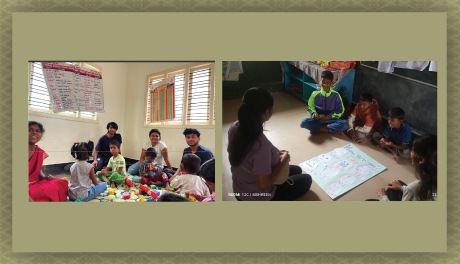
The Community Engagement Programme collaborates with local Anganwadis and government primary schools in the vicinity of Vidyashilp University. Students participate as volunteers in teaching subjects such as English, Mathematics, Arts and Crafts, as well as supporting extracurricular activities.
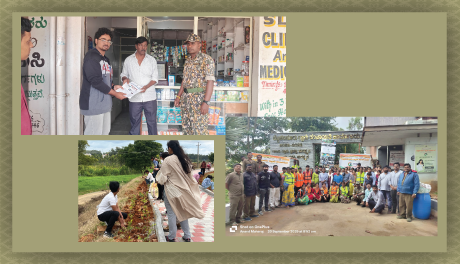
Additionally, the programme promotes community awareness through organising cleanup drives, designing informative posters, and producing videos on important topics such as segregation of wet and dry waste and accessible legal services. Students have also contributed to mental health awareness by creating informational handouts for the community mental health initiative.
Health and Wellbeing
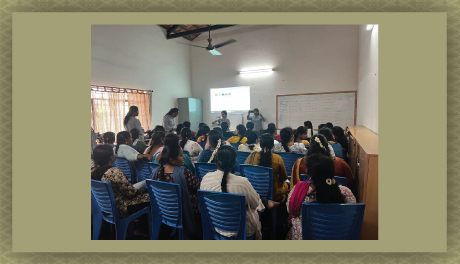
Promoting physical and mental well-being and raising awareness are essential components of our community engagement efforts.This is primarily accomplished through the Community Mental Health Initiative, which provides resources on mental health in regional languages and conducts awareness sessions for women in the community.
These sessions are led by faculty members and external experts in women's mental health and social work, covering topics such as mental health in daily life, stress and anger management, the connection between mind and body, and suicide prevention. Additionally, students volunteering at anganwadis support ASHA workers in their daily activities, further contributing to community well-being.
Environment and Sustainability
The community engagement program partners with organisations such as Ecogram of TAICT and the Satya Foundation, which focus on solid waste management in urban and peri-urban areas, as well as lake conservation.
Student volunteers receive training through these organisations and apply their knowledge both on the VU campus and in neighbouring communities. Student groups have conducted mapping of local lakes and submitted recommendations to the respective Gram Panchayats to promote improved conservation practices. Additionally, they have surveyed nearby villages regarding waste segregation practices in collaboration with Ecogram. Students also conducted a thorough audit of Vidyashilp University’s waste management practices and submitted a detailed report on creating a sustainable and green campus, which was taken up by the administration.
- Studio Regeneration Studio Regeneration is a community and ecology project under the VUCADI(Vidyashilp University Centre for Art, Design and Innovation), which operates in collaboration with the community engagement programme. The studio regeneration project involves the careful study and mapping of: public spaces; potential territories for regenerative public landscapes/parks connected to Panchayats (rural administrative unit); Lakes as dynamic centres for communities, etc. These concrete places and contexts can be declared as an open but curated playground of wider scale in the city of Bengaluru, and make it internationally known. Such a map can attract other creative or ecological groups to contribute and join a larger initiative, which can become a case study for many other cities in the world sharing similar conditions of rapid urbanisation.
- Slow North Map – Research/Website: A Database with photographs, maps, descriptions and analyses: identifying potential spaces for intervention and collaboration. The map should contain: public spaces, parks, natural landscapes, lakes and connected communities, NGOs active in North Bengaluru, local cultural/creative centres, artisans and craftspeople, and companies developing North Bengaluru.
- Regenerative Urban Farming at Campus: As part of a workshop, students built wooden raised beds and created a constellation for an outdoor classroom for future meetings. Using the Lasagna Gardening* method, with the involvement of the students, the small farm can still deliver some vegetables and spices for the VU kitchen.
- Regenerative Public Landscape (park): In Cooperation with the local Panchayat and School of Law, Vucadi is developing worlds 1st regenerative public Landscape on the 2 acres of proposed land. The territory already has the status of a public park. It has wonderful trees, a pond and a whole habitat of animals. Raumlabor renown architect group from Berlin, who initiated Floating University in Berlin, are invited to develop an intervention in relation to the pond. It will be the first case and experience of designing the existing landscape by regenerative methods and make simultaneously a public space in the soon urbanising part of Bengaluru.
Legal Support
Vidyashilp University is committed to advancing clinical legal education and ensuring access to justice for all, especially for the weaker and marginalised sections of society. As mandated by the Bar Council of India and the Legal Services Authorities, Law Universities and Law Colleges must establish Legal Aid Clinics.
These clinics play a crucial role in translating legal education into meaningful social service while strengthening the legal system’s reach at the grassroots.
What is a Legal Aid Clinic? A Legal Aid Clinic is a community-oriented justice centre where trained law students, under the guidance of faculty and legal professionals, provide free legal guidance and support. At the clinic, individuals can:
- 1) Share their legal concerns
- 2) Understand their rights and entitlements
- 3) Receive guidance on government schemes and legal remedies
- 4) Be connected to appropriate authorities or institutions when required
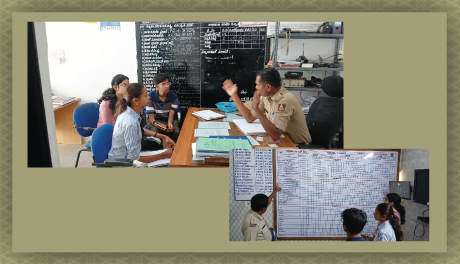
Our Approach Vidyashilp University has established its Legal Aid Clinic both on campus and off campus. While the on-campus clinic serves as a learning and training space for students, the off-campus clinic is located within the Panchayat, taking legal services directly into the heart of the community. This approach reflects our belief that true legal education must go beyond classrooms and courtrooms. By situating the clinic within the community, we ensure that legal awareness and support reach those who need it the most.
- 1) To empower citizens with legal knowledge
- 2) To protect the rights of vulnerable and marginalised communities
- 3) To resolve local issues peacefully and lawfully
- 4) To make justice accessible, inclusive, and effective
Sports and Culture
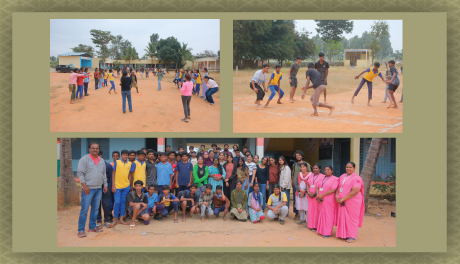
An integral aspect of community engagement is fostering opportunities for connection and collaboration. To support this goal, the student engagement component of the community program organizes Sports and Cultural Festivals on alternating academic semesters.
These events are conducted in partnership with local communities, artisans, educational institutions, and panchayats, encouraging participation from university members and residents of surrounding areas in a variety of activities.