
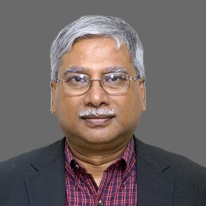
Prof. P.G. Babu
Vice-Chancellor,
Vidyashilp University,
Bangalore

When we look closely at the world around us, it becomes clear that while tools and technologies emerge and evolve rapidly, the underlying principles of understanding-thinking from first principles, learning with peers, solving problems collaboratively-remain constant. These practices, long embedded in elite graduate institutions, are only now finding meaningful expression in India’s undergraduate liberal arts landscape. Yet, the rigidity of traditional curricula, the separation of undergraduate and graduate faculty, and the slow pace of change in core courses continue to hold back true academic innovation. This is shifting. Big data, AI, climate change, and global systemic transitions demand interdisciplinary thinking of a kind that older institutional cultures rarely encouraged. We are now living in a “large deviations” world, one shaped by non-linear challenges that cut across economics, technology, environment, and society. Many professions will be altered, remade or replaced; work weeks may become shorter; and economic mobility will look very different for the next generation. Policies such as NEP 2020 attempt to usher in flexibility and interdisciplinarity, but their success depends on institutions cultivating openness, better-trained faculty, and the capacity to adapt. The challenge is to ensure that such a radical change does not remain the privilege of a few elite institutions. Technology-enabled personalised learning, slow-track options, and flexible, student-specific pathways can broaden access, provided we solve the pedagogic and infrastructural challenges they entail. At its heart, liberal arts education offers a freedom earlier generations rarely had-the freedom to explore multiple passions, to use one discipline as a lens to understand another, and to build a toolkit rather than a single skill. This need for interdisciplinarity is not abstract; it plays out in everyday phenomena- showrooming or ‘Shop-in-Shop’ in retail, the economic reasoning behind safety laws, or the application of AI to market design. Across sectors, nonlinear shifts are redefining how we learn, work, and solve problems. Higher education must respond by widening access through technology, embracing experiential learning, strengthening continuous assessment, and nurturing the mindset of lifelong learning. Flexibility, adaptability, and the ability to think across domains will define a student’s success. New universities are uniquely positioned to lead this shift. At Vidyashilp University, disciplines intersect naturally-economics with psychology, law with economics, AI with business, design with communication and modern market structures. In this youthful, questioning, outcome-oriented environment, no idea is beyond scrutiny, and no single tool is sufficient. With a broad toolkit of methods, experiences, and perspectives, students learn to navigate complexity rather than simplify it. In a world that demands multidimensional thinking, Vidyashilp University offers a home for intellectual freedom, exploration, and a life-changing education.
Prof. P.G. Babu
Vice-Chancellor,
Vidyashilp University,
Bangalore
When we look closely at the world around us, it becomes clear that while tools and technologies emerge and evolve rapidly, the underlying principles of understanding-thinking from first principles, learning with peers, solving problems collaboratively-remain constant. These practices, long embedded in elite graduate institutions, are only now finding meaningful expression in India’s undergraduate liberal arts landscape. Yet, the rigidity of traditional curricula, the separation of undergraduate and graduate faculty, and the slow pace of change in core courses continue to hold back true academic innovation. This is shifting. Big data, AI, climate change, and global systemic transitions demand interdisciplinary thinking of a kind that older institutional cultures rarely encouraged. We are now living in a “large deviations” world, one shaped by non-linear challenges that cut across economics, technology, environment, and society. Many professions will be altered, remade or replaced; work weeks may become shorter; and economic mobility will look very different for the next generation. Policies such as NEP 2020 attempt to usher in flexibility and interdisciplinarity, but their success depends on institutions cultivating openness, better-trained faculty, and the capacity to adapt. The challenge is to ensure that such a radical change does not remain the privilege of a few elite institutions. Technology-enabled personalised learning, slow-track options, and flexible, student-specific pathways can broaden access, provided we solve the pedagogic and infrastructural challenges they entail. At its heart, liberal arts education offers a freedom earlier generations rarely had-the freedom to explore multiple passions, to use one discipline as a lens to understand another, and to build a toolkit rather than a single skill. This need for interdisciplinarity is not abstract; it plays out in everyday phenomena- showrooming or ‘Shop-in-Shop’ in retail, the economic reasoning behind safety laws, or the application of AI to market design. Across sectors, nonlinear shifts are redefining how we learn, work, and solve problems. Higher education must respond by widening access through technology, embracing experiential learning, strengthening continuous assessment, and nurturing the mindset of lifelong learning. Flexibility, adaptability, and the ability to think across domains will define a student’s success. New universities are uniquely positioned to lead this shift. At Vidyashilp University, disciplines intersect naturally-economics with psychology, law with economics, AI with business, design with communication and modern market structures. In this youthful, questioning, outcome-oriented environment, no idea is beyond scrutiny, and no single tool is sufficient. With a broad toolkit of methods, experiences, and perspectives, students learn to navigate complexity rather than simplify it. In a world that demands multidimensional thinking, Vidyashilp University offers a home for intellectual freedom, exploration, and a life-changing education.