
ETHNOGRAPHY LAB
A Research Initiative to build an Intellectual Community
The Ethnography Lab is an initiative of the School of Liberal Arts and Design Studies – anchored under the Vidyashilp Research Centre – to facilitate conversations on ethnographic research. It provides both faculty and students a platform to collaborate on ethnographic research with stakeholders inside and outside the university. It is also an intellectual community and resource centre for a wide community of researchers engaged in ethnographic research methods.
OBJECTIVES
MEMBERS
Dr. Ranjana Raghunathan : is an Assistant Professor of Sociology at the School of Liberal Arts and Design Studies at Vidyashilp University, Bangalore, India. At Vidyashilp University, Ranjana set up its Ethnography Lab to facilitate conversations on ethnographic research and writing among academics, students, and stakeholders in the wider community. She is currently a Primary Investigator on an urban ethnography project about Bangalore and a co-investigator in an interdisciplinary project on religiosity and well-being. She has setup the VU Wellness Centre along with Dr. Setu G. Havanur, and they coordinate its activities together. Her other research interests are in Anthropology of Kinship & Relatedness, Phenomenology of Religion, and Everyday Life. She received her PhD in 2020 from the National University of Singapore (NUS), where she also taught undergraduate and interdisciplinary courses. She has won two student-nominated teaching awards during her stint in NUS. Ranjana has also taught graduate research courses to development practitioners in Singapore and worked in the non-profit sector for over a decade prior to her foray into academia. Her work has been published in peer-reviewed journals and edited volumes. Her doctoral thesis also won the Ground-breaking Subject Matter Accolade at the International Convention of Asia Scholars Book Prize 2021 and the Best PhD Dissertation in South Asian Studies award in NUS for 2020.
Dr. Roopa Madhav : belongs to the first batch of the NLS Bangalore’s B.A. LLB (Hons.) program, the first of its kind in India. Soon after her Bachelors, she worked as a litigating lawyer and was one of the founders of the Alternative Law Forum in Bangalore. She has an LL.M. from the New York University (NYU. and Ph.D. from the School of Oriental and Asian Studies (SOAS) at University of London. After close to a decade of practice in labor, service, property and commercial law, independent research, and visiting Professor positions, she joined Tata Institute of Social Sciences Mumbai (TISS) as Associate Professor. She was the Chairperson of the Center for Water Policy, Regulation and Governance which offers two interdisciplinary Master's programmes, one in Regulatory Governance and the other in Water Policy and Governance. She is currently involved in another capacity building exercise of a joint LL.M programmes on EnvironmentalJustice in South Asia, with SOAS, at NLU Delhi, initially as Professor of Law (Research) and now in the capacity of a Visiting Professor. She has worked with several international organisations such as WIEGO (Women in Informal Employment: Globalizing and Organizing) and IELRC,(International Environmental Law Research Centre) and has served as member of several working groups on water set up by the Planning Commission of India. She has published widely in the areas of environmental law, labour, and human rights. She has wide experience in several dimensions of legal practice, entrepreneurship, leadership, collaboration, internationalization, teaching and research. Prof. Madhav has been the Managing Editor of JNLUD, and is currently a co-editor of LEAD (Law, Environment and Development), a journal published jointly by SOAS and IELRC Geneva. Her more recent work is a co-edited book along with Dr. Thomas Coggin, University of Witwatersrand) titled Mapping Legalities - Urbanisation, Law and Informal Work (Routledge, 2024) – a collaborative effort between WIEGO (Law Programme) and International Research Group on Law and Urban Space (IRGLUS). Her current research includes an ICSSR project on Domestic workers in India and she is also a co-PI with Prof. Philippe Cullet (SOAS, London) on a research grant from the European Research Council (ERC) focusing on the Muti-scalar Dimensions of Sectoral Water Conflicts in South Asia (2024-2029).
Muralidhara TR: A resident Ph.D. scholar at Vidyashilp University, Muralidhara’s research focuses on alternative pedagogies and curricula in STEM education. With a professional background spanning the corporate sector and diverse educational settings, his academic interests are shaped by extensive teaching experience across IG, IB, ISC, and CBSE curricula. His passion stems from his observations and interactions with students in various educational settings, shaping his ongoing research into innovative educational practices. Currently, Muralidhara is pursuing research at VU, where his work focuses on alternative pedagogies and curricula in STEM education.
Gaana Reddy: A full-time Ph.D. Scholar at Vidyashilp University studying the gendered manifestations of narcissistic abuse in intimate relationships. A postgraduate in Forensic Psychology, Sheffield Hallam University, Gaana is interested in the lived experiences of survivors of narcissistic abuse and how gender and societal norms shape these experiences. Further, she is also conducting virtual ethnographic research on Instagram to uncover the discourse on narcissism and narcissistic abuse on online platforms.
Abhishek B S: An Adjunct faculty at Vidyashilp University, and is currently pursuing a PhD in Social Anthropology. A postgraduate in Media and Cultural Studies, Abhishek is interested in stories of migration and everyday life in the cities, and is undertaking ethnographic research in neighborhoods located within urban peripheries of Bangalore.
THE ETHNOGRAPHY LAB
Ethnography Lab is a space to collaborate on interdisciplinary research projects across different schools at Vidyashilp University and beyond. Some of the research projects are listed below:
Urban Neighbourhoods and Ethnohistories: This is an ongoing research project led by Dr Ranjana Raghunathan. The research aims to trace the social life and transformations of select neighbourhoods of Bangalore through long-term fieldwork and oral histories. This ongoing work is also a crucial pedagogical tool for the university undergraduate courses on ethnography, community engagement and gender studies, where the city neighbourhood and urban transformations are studied through various perspectives.
Living Laws Project (Dr.Ranjana in collaboration with Prof. Roopa Madhav from the School of Law): The Living Laws project is an attempt to uncover and document indigenous epistemologies that are otherwise ignored as being ‘tribal’ or as part of the esoteric. The project acknowledges spiritual governance as an important entry point and the lens from which cultural norms and everyday practices that protect and preserve key natural resources, kinship and community may be understood. The attempt at co-creation of knowledge allows for an innovative mode to record and acknowledge the indigenous legal order as legal pluralism that has the potential to inform modern legal systems.
Tracing Urban Transitions (Dr. Ranjana in collaboration with Ms Ranjani Balasubramanian from the School of Design): This research is located at a site in the northern periphery of Bangalore. Conceptually, the inquiry is situated at the intersections of urban anthropology, urban design and transition studies, in an attempt to uncover its erased past and possible future imaginations.
Research on Urban Neighbourhoods: Areas of any city or town are rich with historical and anthropological insights. The research on urban neighbourhoods aims to trace the social life and transformations of select neighbourhoods in diverse urban settings, by using ethnographic methods (field observation, interviews, oral histories). PhD and Post-doctorate research scholars are encouraged to apply to work on this research project, which aims to approach urban social life through diverse theoretical lenses, and experiences inflected by gender, class, or religion to name a few. This project is also a crucial pedagogical tool for the university undergraduate courses on research methods, community engagement, gender in India, and Indian cultures.
Workshops and Events
- Dr. Ranjana Raghunathan conducted a professional development workshop for over 100 school educators representing various subject areas at SSRVM School. The session, titled “Ethnography as a Teaching and Learning Practice,” focused on the benefits of integrating ethnographic methods into classroom instruction and broader educational contexts, on 7th September 2023. When applied as a pedagogical approach, ethnography enriches classroom learning by adding depth and nuance, supporting lifelong learning. Rooted in classical principles such as active participation, observation, and attentive engagement with the world, this approach emphasizes experiential learning. The workshop examined strategies for guiding students to explore the world around them, fostering skills necessary for attentive and reflective engagement, rather than solely focusing on traditional knowledge delivery.
- During the "Qualitative Research Methods for Health Sciences" workshop on July 4, 2025 , Dr. Ranjana conducted a session entitled “In Their World: Ethnography and In-Depth Inquiry,” which emphasized the application of ethnographic methods in health and mental health research. The session was both engaging and insightful, designed to promote a multidisciplinary approach for professionals in health and mental health fields.
- The symposium on Urban Ethnography and Bangalore held on 12th and 13th December 2024, brought together scholars and practitioners to explore the layered social, cultural, and ecological realities of Bangalore through ethnographic perspectives. Keynote speaker Prof. Chandan Gowda highlighted the city’s understudied civic culture, shifting linguistic identities, and the complexities of migration, memory, and urban transformation. Discussions emphasized the importance of documenting overlooked histories—such as working class experiences, public health, and the evolution of Kannada activism—and the need for nuanced, locally rooted ethnographic approaches. Sessions showcased diverse methodologies, from sensory ethnography focused on smell and memory to participatory art mapping and long-term neighborhood studies. Presenters examined topics like food culture, cycling communities, gendered experiences, and the socio-material realities of Bangalore’s lakes. The symposium underscored the value of integrating sensory, ecological, and community-based research to reveal the city’s heterogeneity and ongoing transformation.
- Dr. Ranjana conducted a two-day workshop on Ethnography and Education at Gandhinagar, Gujarat, on 5th and 6th March 2026. The workshop aimed to help participants develop a clear understanding of ethnography and explore its application in educational and classroom settings, while also introducing its relevance beyond academic contexts.
-
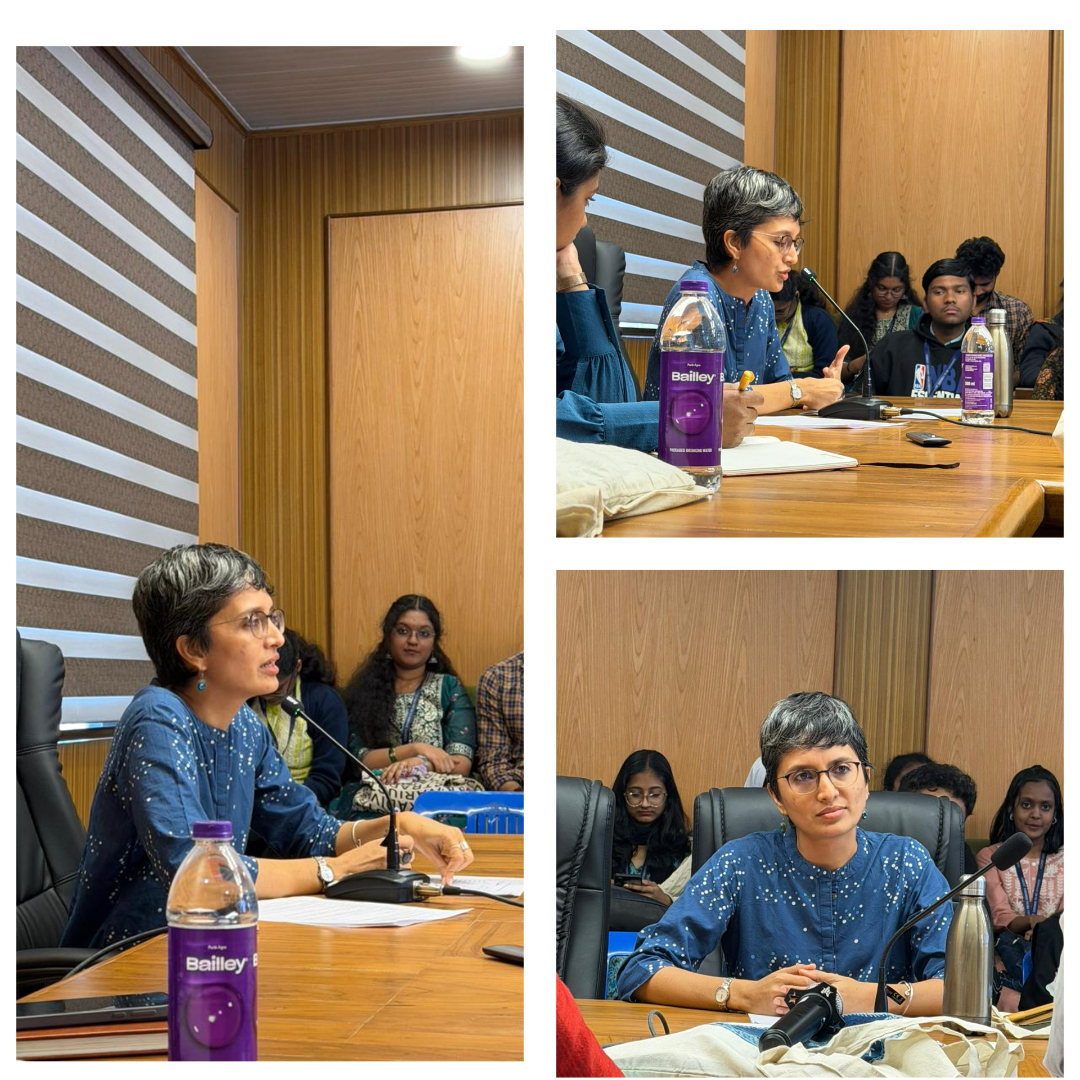
The keynote lecture titled “The Everydayness of Ethics in Ethnographic Research”
was delivered by Dr. Ranjana Raghunathan at the Annual International Conference of
the Tattva Journal of Philosophy, organized around the theme “Living Ethically in the
21st Century”, held on 22nd January 2026.
 The Everydayness of Ethics in Ethnographic
Research
The Everydayness of Ethics in Ethnographic
Research
- Dr. Ranjana was a discussant at the conference “Ethnography, and film” held at Christ University between 7th-10th January 2026. DATE. The aim of the conference was to open a space for reflection on the potentials and tensions of the “ethnographic gaze” in film, as well as the capacity of film to interrogate, complicate or even invert that gaze.
- The two-day symposium, scheduled for September 2026, is designed for graduate students seeking a foundational understanding of ethnography as a research approach. The symposium aims to introduce ethnography not merely as a set of qualitative methods, but as a distinct epistemological and methodological orientation grounded in long-term engagement, reflexivity, and contextual meaning-making. Through panel discussions, paper presentations and applied sessions, participants will be encouraged to critically examine the differences between ethnography and broader qualitative research, and to explore how ethnographic thinking can inform research design across disciplines.
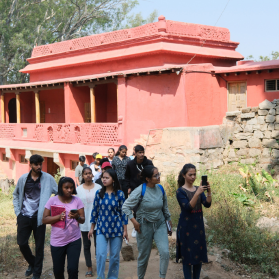
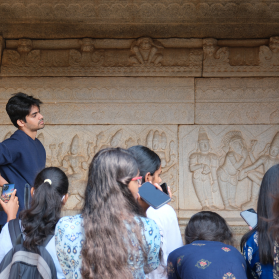
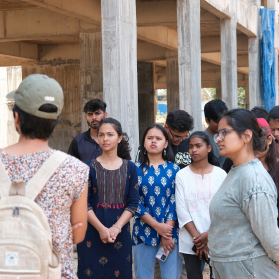
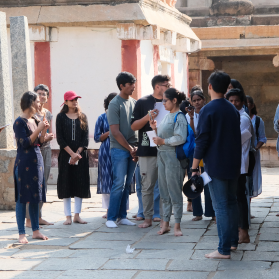
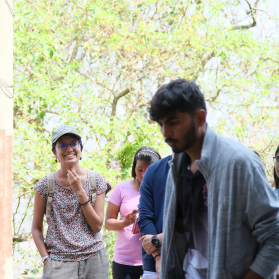
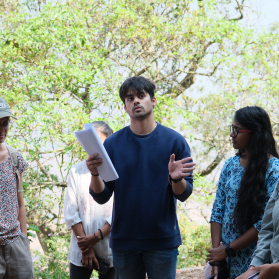
- Undergraduate students have the opportunity to collaborate with faculty and research scholars, through their courses on ethnography, community engagement and gender studies to understand the city neighbourhoods through ethnographic research methods. Students’ innovative research using walking and sensory ethnography have resulted in inter-disciplinary projects and field experiences for other undergraduate students.
- Ethnography Lab has conducted workshops on research methods in diverse contexts and on incorporating ethnographic sensibility in pedagogy and critical reflexive practice.
Upcoming Events:
Teaching and Pedagogy:
Ethnographic Field Work
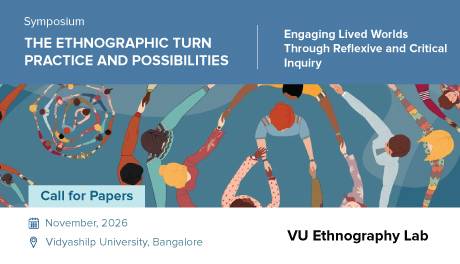
The Ethnography Lab, School of Liberal Arts and Sciences, Vidyashilp University, invites submissions from late-stage PhD Scholars and Early-Career Researchers for the Ethnography Symposium, to be held on 12th and 13th November, 2026.
Centre for Market Regulations and Governance (CMRG), Vidyashilp University, invites registrations for the workshop on "Responsible Regulation: Regulatory Impact Assessments and Public Consultations" held on 8th–9th May 2026.
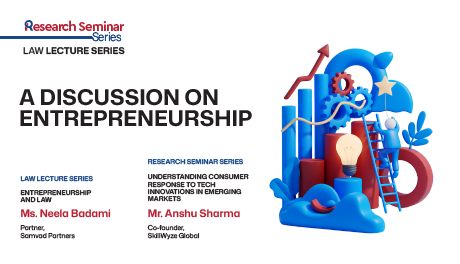
An event featuring two focused sessions at the School of Law, Vidyashilp University, bringing together entrepreneurship law and consumer behaviour, with practical, application-led insights.